Resistance & Rhinestones - Mardi Gras and Queer Joy
written by by Erica
“You know what you could do?”
It’s Mardi Gras season in New Orleans. It’s cold outside, in a way that would make most people in the Northern Hemisphere scoff. In the humidity and poorly insulated buildings here on the Gulf Coast, it chills you to the bone. I’m sitting at my desk, my work computer firmly shut and set aside, sewing thin twisted red rope to a straw hat that’s been spray painted black. I am in a fight with this hat and I am losing— there are drips and globs of hot glue in places they do not belong. I resent this hat for being necessary to the final *look*. I’m furious with myself for every decision that led me to this point. Also, I’m absolutely thrilled.
I stab myself with the needle because I’m not paying attention.
“Ow, what?”
“You could leave that part of trim like, draping over the side.”
I perk up at this idea, mostly because it means I can stop sewing into this godforsaken straw, because, if it is not yet clear, I hate this hat.
“OooOooo like this?”
I throw my enemy (the hat) on top of my head and model for the other people in the room. The hot glue bumps irritate my forehead. Or is that the straw poking out? Why did I pick a straw hat? Could I add felt to soften it? No, that would only make the fit tighter.
I don’t love how the trim looks dangling over the side, it feels a bit unfinished, but I certainly don’t want to sew it anymore. I put down the hat and walk away, believing that the right decision will come to me later.
These are the moments when I am most myself. These are the moments that I remember, oh yeah, that’s why we do this. These are the moments of Mardi Gras.
Mardi Gras moments are quiet— having a costume idea as you reach into the now-room temperature box of pizza and try to figure out which Diet Coke was yours. Then the idea works! You’re beautiful— although, of course, you always have been.
Mardi Gras moments are big— overlooking the river, with crisp late winter wind threatening to blow your headpiece right off your head and into the Mississippi, as you hear the names of the krewe members that have died. Someone brings ashes or a memento to release into the river. The tears fall, you take a moment, and then the music starts to play again.
Mardi Gras in New Orleans has a long history as one of the best-known carnivals in the world.
You’ve probably seen photos - floats, beads, feathers, glitter, costumes, and lots of rhinestones. The start of the tradition was French colonizers on the Gulf Coast, but historians disagree on where - some say 1703 or 1711 in Mobile, Alabama, some say 1699 in New Orleans. Like much of history, the story of Mardi Gras is full of racism, homophobia, and violence, right alongside hope, community, love, resistance, and ritual.
No sugarcoating - some of the history here is bleak.
For several hundred years, krewes were officially divided along racial and ethnic lines. Unofficially, they often still are. Different blocks, street corners, parades, balls, and spaces are still *for* certain groups of people, though it was all technically desegregated years ago. When City Council passed an ordinance that required krewes to certify publicly that they did not discriminate based on race, some of them chose to stop parading altogether rather than open their rosters.
Within that discriminatory and segregated structure, black and gay krewes built their own history and found their own ways to joy. These days, many different identity groups host parades that celebrate their heritage and history - the Krewe of Chickpea, the Krewe of PhantAsia.
Given the presence of rhinestones, feathers, and a sense of dramatic flair, it makes sense that queer people have been putting on Mardi Gras balls and ballgowns. Mardi Gras just…. feels really queer.
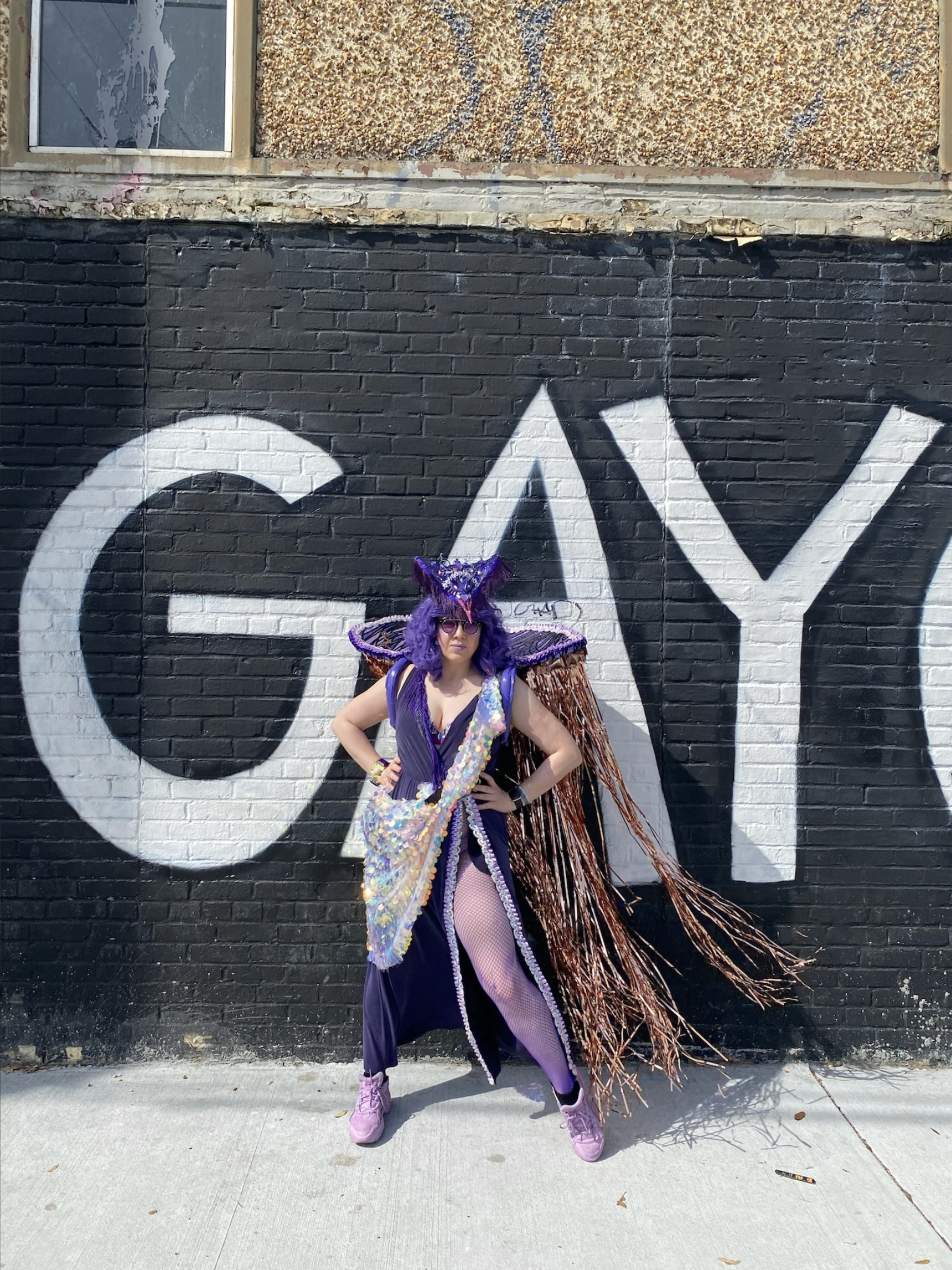
The first explicitly gay Mardi Gras krewe was the Krewe of Yuga in 1958 (legend has it that the name is a play on the question… “You gay?”). At a time when queer bars were regularly raided and people were legally required to wear at least 3 pieces of clothing aligned with their gender, there was some safety in the costumes of Mardi Gras. Different krewes would gather, form, and disband many times over the years. Bars and krewes shut down for various reasons— sometimes a bad breakup amongst leadership, sometimes no money or poor organization.
Then, the AIDS crisis hit, everybody was dying, and entire parts of the community were lost. Krewes and queer bars faded to just a handful left in the city by the end of the 90s. Now, there are several officially recognized queer Mardi Gras krewes as well as many unofficial ones.
There are as many versions of Mardi Gras as there are people who attend it - some counts put the number as high as over a million each year. My celebration of Mardi Gras has always felt deeply queer. In my entire life I’ve only missed one Mardi Gras Day, and missing one was enough for me to learn that I never want to miss another.
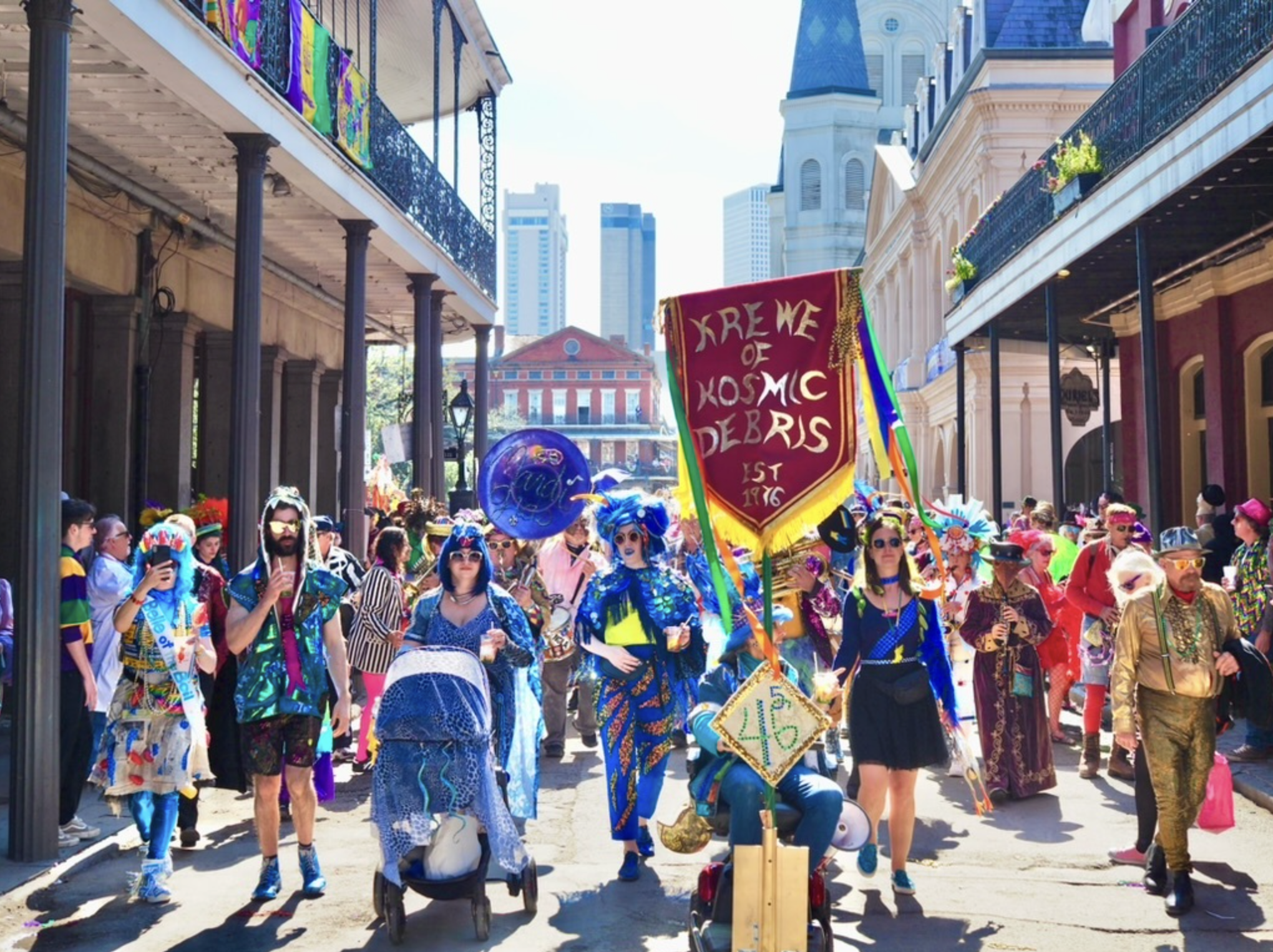
The longest standing tradition in my family is the Krewe of Kosmic Debris, a marching club founded in 1976 by Alan Langhoff, my dad.
Dad ran a music club on Frenchmen Street, one of the first institutions in the now famous neighborhood of bars and music clubs. Krewes are often linked to a physical place — a bar or a den— where the members gather to plan and to celebrate. While Dad is straight, he always stayed close to the queer community and bars downtown. The now-famous Southern Decadence festival started as a much smaller party that Dad actually attended, dancing through the French Quarter in pearls, a mink stole, and not much else. One of his mother’s neighbors saw him and the story eventually made its way back to my grandmother.
“Alan,” she said, gently and a bit surprised. “Why didn’t you tell me you were gay?”
These are stories that I heard growing up, told to me by my parents and by some of their gay friends. My lesbian de-facto aunts knew the ins and outs of New Orleans’s bustling queer bar scene when it thrived in the 70s and 80s. Simply having known queer adults when I was a child is a gift I’ll never take for granted. As I grew up and came out, I learned how rare that was.
I’m 38 now, and thinking about how my queerness shows up day to day. It shows up a lot in what I wear. My presentation at any given moment ranges from tomboy camp counselor who also wears red lipstick to hyper-femme glitter maven to gym rat trying to get strong to punch Nazis.
What does it mean to me to be out, to be visible, and what am I willing to risk?
Those moments are smaller than I thought they would be, and they’re easy to miss. Coming out, for me, has been less one sweeping declaration and more casually dropping the phrase “my ex-wife” into conversation several times a week. I must say, this phrase brings me so much joy - it very quickly communicates: I am queer and I have lived!
What a gift that at Mardi Gras, I get to show the world myself however my wildest dreams and available supplies happen to guide me. I spend an entire day ritualizing my love for the world and for myself, along with a few hundred thousand of my closest friends.
It is an act of resistance I will clench in my limp-wristed hands until my last breath.
What exactly are we celebrating? Good question. The Catholics generally think of it as a feast before the fast of Lent. Personally, I’m celebrating the simple magic of being alive.
Mardi Gras is unity.
We gather together— on the sidewalk, outside the bar, in krewe dens, on the neutral ground, under the tent, at the table, in ballrooms, at the grocery store, on floats, at the craft store - to celebrate. Out of town travelers become your neighbors, your neighbors become your family, your family becomes your friends, your friends become your co-pilots. All kinds of joy get to live together in a tapestry - black joy, queer joy, New Orleanian joy - if you can show up with love and not be an asshole, there’s a place for you.
Mardi Gras is authenticity.
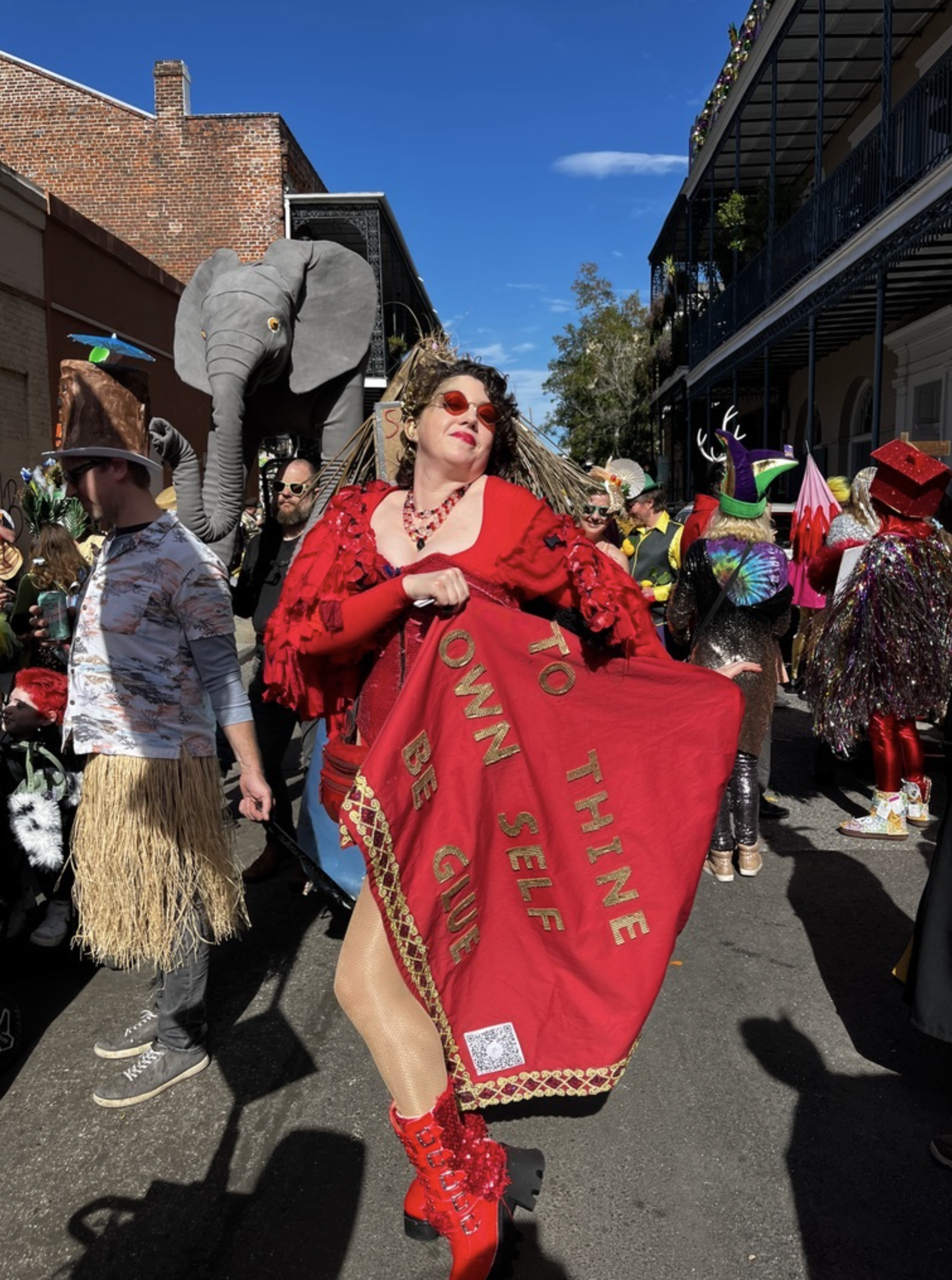
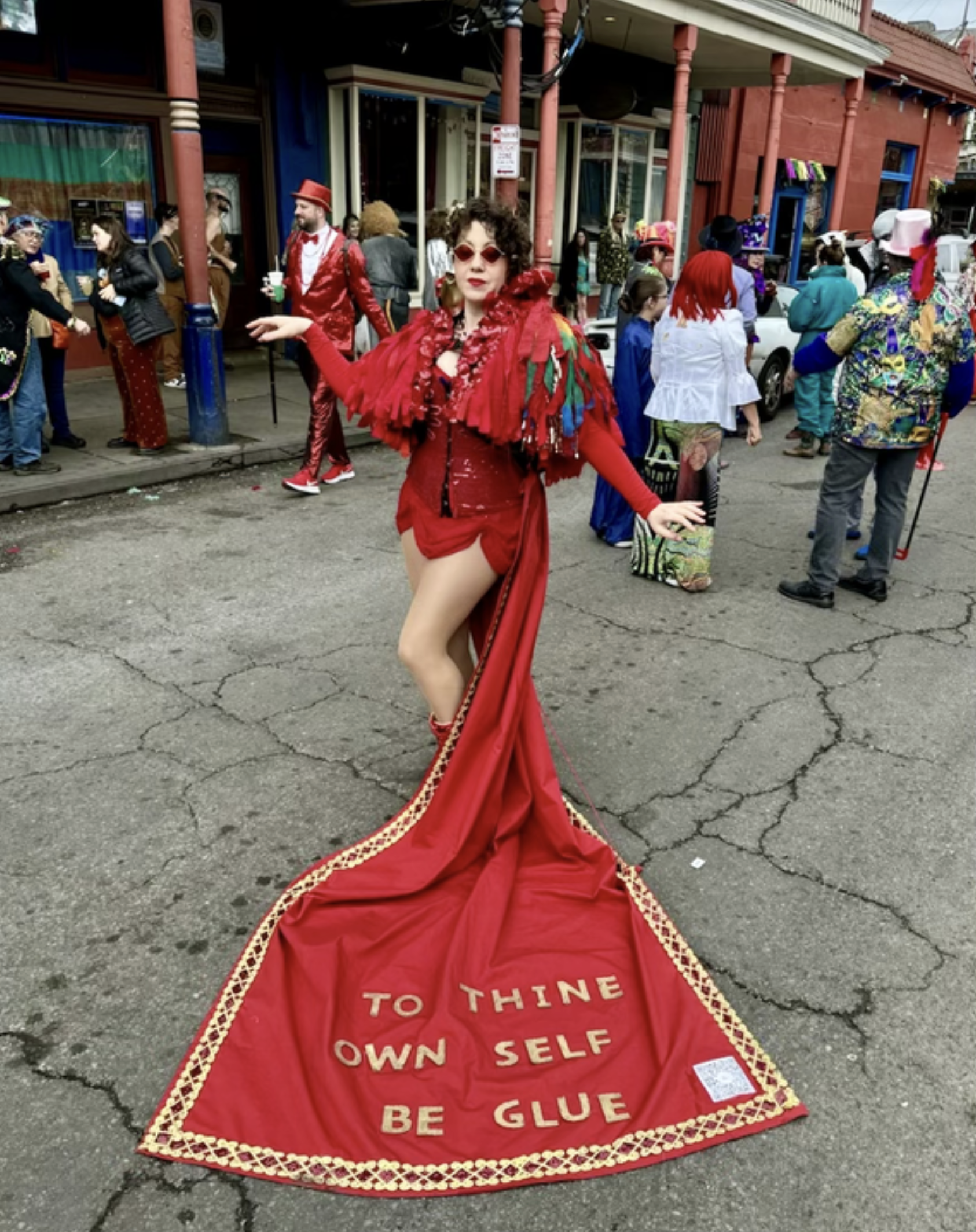
This isn’t Halloween, you don’t have to *be* anything. Each costume becomes a layer, an enhancement, a crust, a fresh veneer of whatever version of yourself wants to surface for a day. For me, this usually involves an embellished corset, a statement headpiece, and a sturdy pair of dance tights. For others, it’s a papier-mâché mask, head to toe fringe extravaganza, colorful body paint, yards of sequin trim, shreds of secondhand leather, a hot pink Chewbacca bodysuit, or a vintage clown costume. No wrong answers, follow your heart, show up however you are today.
Mardi Gras is gaiety.
Tragedy and horror have always existed alongside joy and celebration. We can’t forget what’s worth fighting for, we won’t survive otherwise. I remember the first Mardi Gras after Hurricane Katrina drowned our city and our neighbors. I remember the impossible feeling of heartbreak, and I remember it lifting, just a bit, just enough, for me to breathe again. I had just turned 18. So yes, it’s silly, it’s frivolous, it’s indulgent, and it’s vital. The laughter and the tears will stay side by side. We need them both.
Mardi Gras is commitment.
It takes time, thought, energy, and bandwidth to participate. It takes money, and intention and planning. You need a plan to get there and a plan to get home, a plan to eat and a plan to hydrate, a plan for where you’re going to use the bathroom and you damn well better be wearing the right shoes (For the love of god wear shoes with a wide toe box! Your feet will swell!)
This year, my corset is my armor.
I’ve gone through my pile of broken and old jewelry, trims from the past, forgotten findings and bits and bobs. Rhinestones of every shape, size, and color are glued or sewn into place. These archival pieces sit on top of the boning that both snatches my waist and provides support (seriously, back support on a 25,000 step day is a big deal). Our theme is “gilded debris,” celebrating 50 years of the Krewe of Kosmic Debris. Taking up the pieces and parts. Making something beautiful. Together.
Rhinestones aren’t diamonds. They shine, but they can be crushed. They smudge easily, so don’t forget the Windex. They’re hastily applied with various glues (recommended: E6000) or messy stitching, rather than carefully mounted. They aren’t perfect. Something will always snag on the corner of a loose prong.
“You know what you could do?”
I decide, ultimately, that continuing to sew the fussy twisted trim onto the straw hat is the right move. It’s not ideal, but it will get me closer to my desired result. It’s the next right thing. One step at a time.
“You know what you could do?”
The first march was wild and wonderful. I crawled through a small opening at the back of the cart to climb on top of the handmade float and fulfill my designated parade role of “stage dancer.” There was just a metal railing preventing me from tumbling into the crowd, but it was sturdy enough. In one hand was my glowing staff (a little too heavy, but doable) and on top of my head was that damn hat. A little irritating, but beautiful. Wherever I pointed in the crowd, whoops of joy came back towards me. My cheeks were sore from smiling.
“You know what you could do?”
The morning after, someone in the group chat sent a screenshot with protest logistics for the afternoon. It was predicted to be rainy and cold again, though at this point I’m not sure how much I trust the weather report. There’s a lot that I don’t trust right now. I put on my boots to march in the streets for the second day in a row, for a different reason this time.
But—is it a different reason? If the reason is so different, why are the contents of my bag so similar? If the reason is so different, why do I feel the same?
“You know what you could do?”